
Frames Within Frames: The Invite and Olivia Wilde's Chamber Comedy of Self-Worth
The Invite uses a meticulously designed apartment to explore a failing marriage and different ideas about relationships.

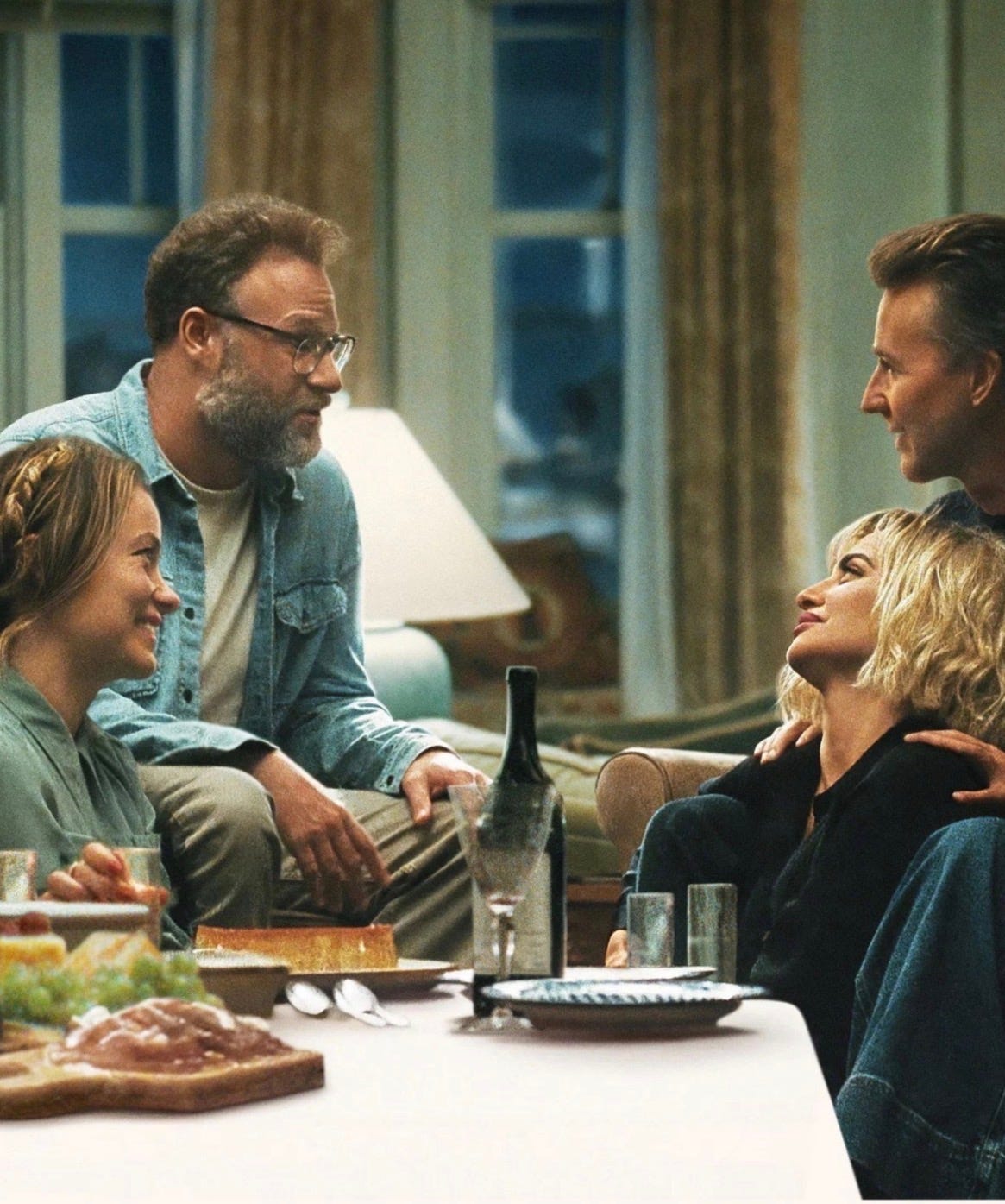
The Invite takes place almost entirely in a single apartment with just two couples, so it often feels similar to a play. We have one set, four actors, and long, dialogue heavy scenes. This makes sense once you remember that the film adapts a Spanish feature that was itself based on Cesc Gay’s stage play Els veïns de dalt / Los vecinos de arriba (The upstairs neighbours / The neighbours upstairs).
However, Olivia Wilde makes full use of the apartment, and her collaboration with Adam Newport-Berra turns what could feel like a stage piece into something fully cinematic. Unlike a stage production, where we choose where to look, the film uses direction and shot composition to guide our eye toward particular spatial relationships and to give us perspectives that are significant to the story.
The story follows Joe (Seth Rogen), a once promising musician now teaching jazz at a high school. He comes home to find his people pleasing, stay at home wife Angela (Olivia Wilde) has invited their noisy upstairs neighbours Pina (Penélope Cruz) and Hawk (Edward Norton) for a last minute dinner. Over an increasingly hectic night of bad hosting, and bickering, the neighbours reveal that their loud late night activities are regular swinging parities and that they hope to invite Joe and Angela to join. They are testing the couple’s curiosity and exposing how little intimacy is left in their marriage.
That straightforward setup of a last minute dinner and a wildly inappropriate invitation quickly becomes a way of showing how much of Joe and Angela’s shared life depends on performance.
From the neighbours’ very first arrival, there is a break in the night’s reality. The first doorbell cuts through Joe and Angela’s argument, the screen goes black, and the title “The Invite” appears, so everything that follows is a response to that interruption. The neighbours are here now, and the couple has to pretend to be cheery, although Joe seems far less invested in keeping up the pretence than Angela. That cut to black and the title card after the doorbell work like a stage direction, indicating that the next part of the night will be performed for them. But it is done in a way that works in a normal mundane setting, our guest have arrived so we must be pleasant. Throughout the film, these stage directions are everyday objects or cues turned into symbols. When Angela opens the door, the dreamy piano score and her huge smile work hard to hide the irritation from her bickering with Joe seconds earlier, but the intense acoustic cello composed by Devonté “Dev” Hynes, which usually plays during the heated scenes, sticks to Joe’s lines, keeping the air thick with tension. The strings are playing fast and competing with the argument to hammer in that screwball velocity where comedy is born from chaos and annoyance. The arguments drown out nuance much like the score overwhelms subtler feelings. It is an obvious cue but perfectly fitting.
Where the characters choose to stand during this introduction is equally as important. Joe in particular does not move toward the door; he stands at a distance, and the camera hangs back with him as if we are watching the interaction from his point of view, so the invitation looks like something he studies. Angela is trying to play the perfect host, and Joe’s reluctance keeps poking holes in the role they are supposed to inhabit.
Even before Pina and Hawk arrive, Angela asks for a “reset”. She turns Joe’s entrance into a kind of mini rehearsal to set the tone before there is an audience at the door. She literally makes Joe leave the apartment and come back in again so they can pretend his entrance and the mood between them are nicer than they actually are.
Once the invitation changes from dinner to bed, that performance of normality stretches into a performance of intimacy. Now Joe and Angela are being invited to act out a new version of themselves as lovers, going beyond the respectable marital farce. Here, they are negotiating desire and consent.
For example, when Angela casually comments “DP” while they are all joking about what is on the menu, it is a funny moment because it is clear that she is still trying so hard to come across as cool and as boundless as Pina and Hawk. Joe gives her a quick glance and repeats it in a slightly surprised tone, showing a mix of mild shock, before he quickly redirects his attention to Pina and Hawk’s encounters again. Hawk’s response, though, which pushes back on Angela’s label as he says it is not really their thing, it is too “tropey”, lets him reclaim the power to define what kind of encounter they are talking about, and Joe’s joking riff on that label both defuses Angela’s misstep and keeps the mood going. Angela’s embarrassment, staring at the floor, is followed by her defensive rebuttal you’re a fireman who likes it when the roles are reversed, as if to say he should not judge her when everyone is being free and open here; what is the difference? This is another negotiation, in which she redirects the focus on Hawk, tries to save face, and tests whether she can still control the story everyone is laughing at. It becomes a microcosm of the flow of the evening.
Therefore, it is clear that the negotiation shows in the way they talk their way into the bed invite, by checking what each of them actually wants, making the foursome look like it is something “for” the relationship, joking and stalling to manage consent, and constantly testing who gets to set the pace and the rules once desire stops being theoretical and becomes something they have to act on together.
The apartment stands in for their marriage. Each room and design choice says something about how they think or feel. The whole setting is full of frames within frames, especially doorways and mirrors, and they either box the characters in or separate them. As well as that, the camera angles are sometimes tilted or off centre and we often get partial views in reflections or through a doorway, so the simple conversations also look jarring and incomplete, as if the apartment cannot hold them together in the same frame.
This visual imbalance immediately suggests that Joe and Angela are incompatible. They are subconsciously fighting about everything, including space. The two share a flat but never the same point of view. Furthermore, the bedroom colour is not even painted, and we can assume the two cannot decide on the type of blue, which is why they have three shades that Angela believes are different but Joe thinks they look the same. Thus nearly everything in this apartment looks off or half finished.
Each room corresponds to different way of being together. The living-dining area only opens up in wide, continuous views when the evening reaches crisis points, as if the space itself only becomes distinct when things spill out of control. The bathroom is the one room Angela is most proud of “restoring herself”, and it is important here. Since her marriage troubles, it is obvious that Angela has put all of her energy into redecorating the apartment, and the bathroom is singled out as the place she has tiled and styled herself. When Hawk tours the apartment with her, she proudly points out the domestic effort she puts in and is never thanked for, all the work she has done to make this bathroom aesthetically pleasing, and this excitement over the room shows her need to be noticed and appreciated. This is a finished room, unlike the bedroom, which is full of cracks, unpainted walls and an old mattress. The bedroom’s neglect turns their lack of intimacy and state of arrested development into something we can literally see.
The signs of neglect and overwork go beyond the lack of intimacy, because they also demonstrate how Joe and Angela view themselves. Their self deprecating jokes, resentment about noise, and flirting with the neighbours are all facades, there to hide their pain over their deeper shame about failed or stalled creative careers, and the fact that they lived in an inherited, parent-owned flat, which makes Joe feel he has not genuinely “earned” his life. Class and work are the main issue. There is a sense of San Francisco and more broadly American, anxiety about not being self made, about success being self sufficient and aspirational, and this does not apply to Joe and Angela. Against all of this, the film’s take on non-monogamy and divorce is quite plain. It neither treats open relationships as a magic fix nor cast divorce as a failure. Instead, it suggests that any way of being together, whether that be monogamous or open, is only liveable if the people in it can stand who they are. Once self worth has been worn down by class shame and disappointment, leaving can look like the clearest option, even if the final piano scene does not say outright whether Joe and Angela take that step. Regardless of the outcome, Pina’s suggestion that you can “have a new relationship with the same person… but I think this relationship is over”, seems to be taken seriously by the film. Joe and Angela have finally dropped the social performance of the dinner party, yet they are still playing together at the piano, playing a piece that only works when they listen and adjust to one another. In this new relationship where they may now be separated, the relationship is not completely erased. They finally see the good in what they have (the piano, the shared creativity of music, and their renewed ability to listen and understand each other).
Over the course of the single evening, The Invite uses one disastrous dinner to pull apart every layer of Joe and Angela’s life. Jokes about intimacy and the neighbours’ proposition all become moments that push Joe and Angela to recognise how class, and self-worth have moulded their marriage. By the time they sit down at the piano, the film has shown that they may not be able to keep the relationship in its old form, but it also refuses to deny the fragile value of what they can still do together.