
Crime 101
A moody L.A. heist with real stakes and a surprisingly soft landing.

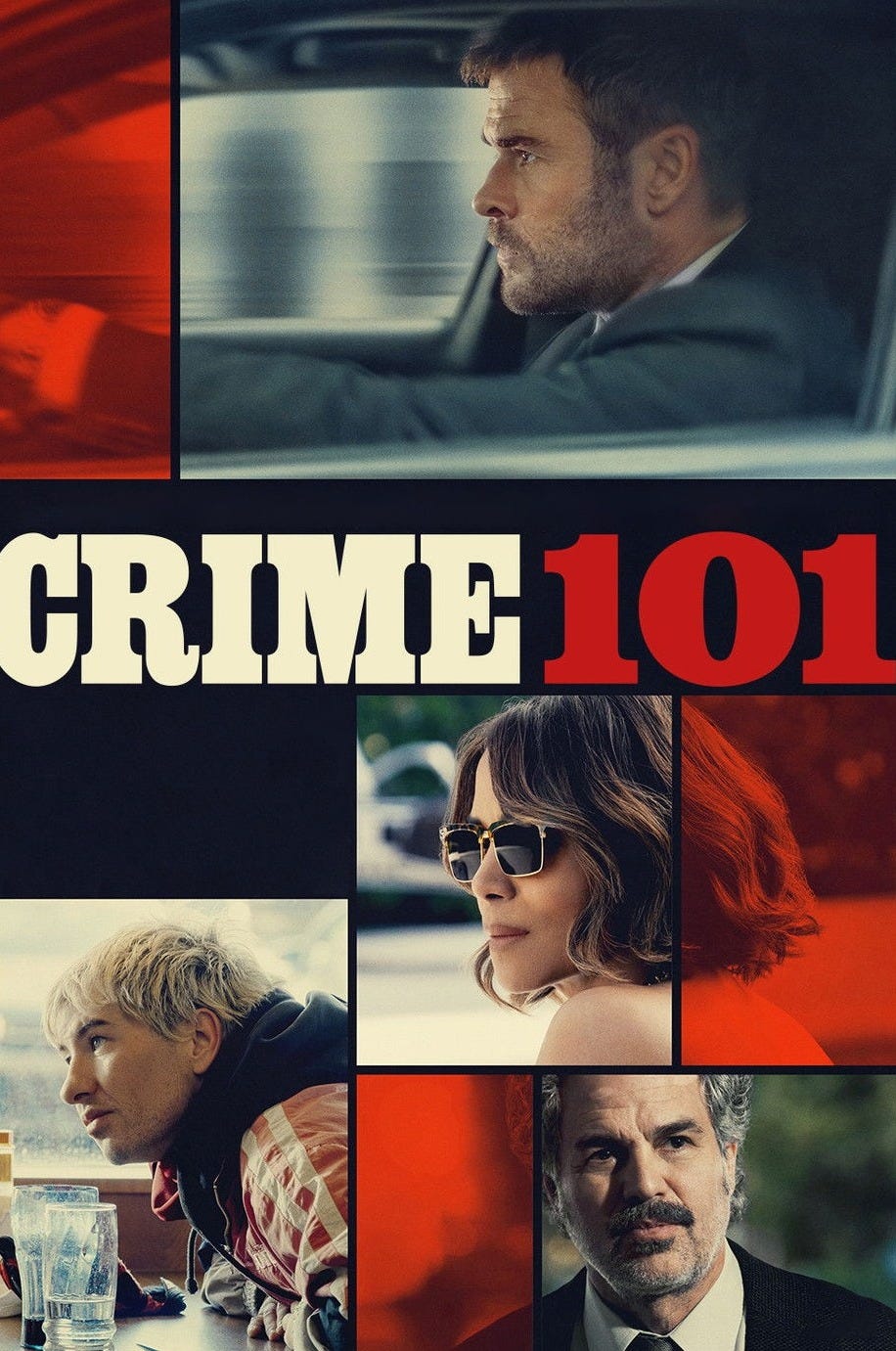
This character-driven crime thriller revives the classic heist movie with some L.A. grit. It’s a pure neo-noir that nods to Michael Mann’s Heat, especially in the cat-and-mouse between thief Mike and detective Lou. It’s a moody little melodrama built around three people. An elusive professional thief, James Mike (Chris Hemsworth), a dishevelled, relentless detective chasing him, Lou (Mark Ruffalo), and an insurance broker, Sharon (Halle Berry), whose firm keeps paying out to the people he robs. Creating a neat little cycle between them.
The title, unfortunately, still sounds like a working title or a name of a course. It does relate to the story, because it refers to the 101 Freeway in California, where the thief commits his crimes. But, beyond that, the film doesn’t return to the freeway idea enough for me to believe that the title is truly.
Crime 101 begins in media res and lets us catch up. The film opens with cross-cut editing and maintains it to link the main characters together. It nails the classic noir feature by pulling their otherwise separate lives into a web of shared destiny.
Once we enter their lives, though, a number of issues arise. Take Mike. There is a huge emphasis on him as this meticulous criminal. He wears contacts and avoids violence to leave zero trace of DNA. Then he abandons his whole MO by driving the wrong way down a one-way street to chase a psychotic criminal named Ormon (Barry Keoghan). The obvious problem is that this could have resulted in a mass casualty. The second problem is that Ormon has been spying on Mike, and Mike is aware of this, so he could have just waited for Ormon’s next stakeout on him. On top of that, an entire subplot is just abandoned and we are left to guess what happens with it. Ormon has been sent in by Mike’s former underworld boss, Money (Nick Nolte), to replace him. Mike then confronts Ormon. So now that he is aware of everything, what happens between Mike and Money? Absolutely Nothing.
Mike’s relationships with other characters are quite dull. His love interest, Maya (Monica Barbaro), has no chemistry with him. She is enamoured with him, and the man barely says two words to her. She constantly asks him questions and he gives short responses, and he never asks her anything in return. I wasn’t sold on what exactly she was drawn to. If they wanted to make it clear that it’s only his looks she is attracted to, then they should have keep it at that. Yet she is disappointed that a man who barely says two words to her in every encounter they have decides not to open up to her about his life.
He is perfectly capable of turning on the charm when he needs to; with Sharon, the conversation comes easy. I guess you can say that this makes sense because he is a professional when it comes to getting the job done. It is a strictly a business move with Sharon. He is performing to get what he needs. Whereas, with Maya, he actually cares about her, so he seizes up and says almost nothing. That could be an intimacy issue, he is vulnerable and does not know how to open up when he cares about someone. Even when he talks to Sharon, she does break his character when she starts guessing about his life and how he grew up poor. Ironically, Mike is awkward with the escort too. However, this is clearly not someone he cares about. But one of the first things he says to the escort is “what happened to Sarah?”. What I inferred from this question is that Mike has built a routine and connection with the usual escort he sees. So when a new woman shows up in that role, it breaks the script and he becomes awkward again. Yet, this instant switch in character whether it be performative or not just makes the underdeveloped dynamic with Maya feel like a writing problem, especially because their encounters are brief. Maya disappears for most of the runtime. Then we jump to the end with Mike now sending a photograph of him and his brothers to her. This is him opening up. But, his “meaningful” little token to her does not feel earned at all. Their relationship does not build up to be of any importance in the film, so the ending does not add anything to the dynamic of their relationship or to the dynamic of the film. Maya’s scenes exist as a filler narrative.
Sharon should have been the catalyst that Maya is supposedly meant to be. She already reads him accurately. He actually acts like a human with her even when he is pretending to be a smooth talker. The way in which she can see through him like no one else is perfect. Chris Hemsworth has the perfect reaction to it. He physically recoils a little bit. His face tightens, and he has a guilty gulp. His act cracks for a second before he ultimately reveals everything to her, leading to his downfall.
More importantly, the film skips over a chance to deepen Sharon’s character. Her arc and motivation are believable. She is an overqualified insurance broker hitting a glass ceiling. She is frustrated enough with her firm’s exploitation, enough so that Mike can plausibly target her. It is a sad situation too, because Halle Berry adds nuance to this role. You can see the tug between anger at her job, curiosity about Mike, as well as her empathy for him. When she analyses him, you can see a calm, certain, and relaxed, gentle expression on her. It is as though she understands him a little too well and is a bit surprised by that. We also see her broken and having genuine fear once things escalate.
Then there is Lou, whose ending flips from dogged obsession to letting Mike walk free (life debt or not), framing Ormon and giving Sharon diamonds. This is justified as being able to happen because the cops are corrupt and Sharon deserves a pay-out. This left me with more questions than answers, such as, how Lou explains being at the heist without exposing Sharon’s guilty tip, and how he explains the hotel cams catching Mike’s escape. The film makes it very clear that the officers are corrupt, with a previous killing of a robber who did not have a gun and was framed as having one to justify the killing. They make it clear that they are not focused on solving the crime, because they just need a story to close a case. But, even this is extreme, especially for a suspended officer working alone. The ending simply missed the grit it had built in the beginning.
Crime 101 consciously models itself on Heat. Yet, it softens many of the film’s harsher edges. Evidently, it wants the moody L.A. crime vibes but with a more crowd-pleasing outcome. This is a neo-noir that’s interested in money, class, privilege and mid-life crises. There are real stakes at play, Ormon’s psychoticism, Sharon’s uncertainty over whether she should continue to work hard or turn to crime, Lou’s job, and Mike’s break of code and ultimate destruction. All of this is dismissed with the safe, crowd pleasing ending. We could have had a realistically legal nightmare, but that is scrapped for a tidy story to where the suddenly corrupt lone officer becomes the story closer.
I love this genre, but your review makes it sound like a bit of a mess? The storytelling seems lazy. Too bad. Good cast, I really like the young actor Barry Keoghan. I’m a sucker for this type of movie and a hopeless film obsessive so I’m probably still gonna watch it. But thanks for the early warning.